Random projects going on in our rock laboratory!
Blue-Fluorescing Willemite
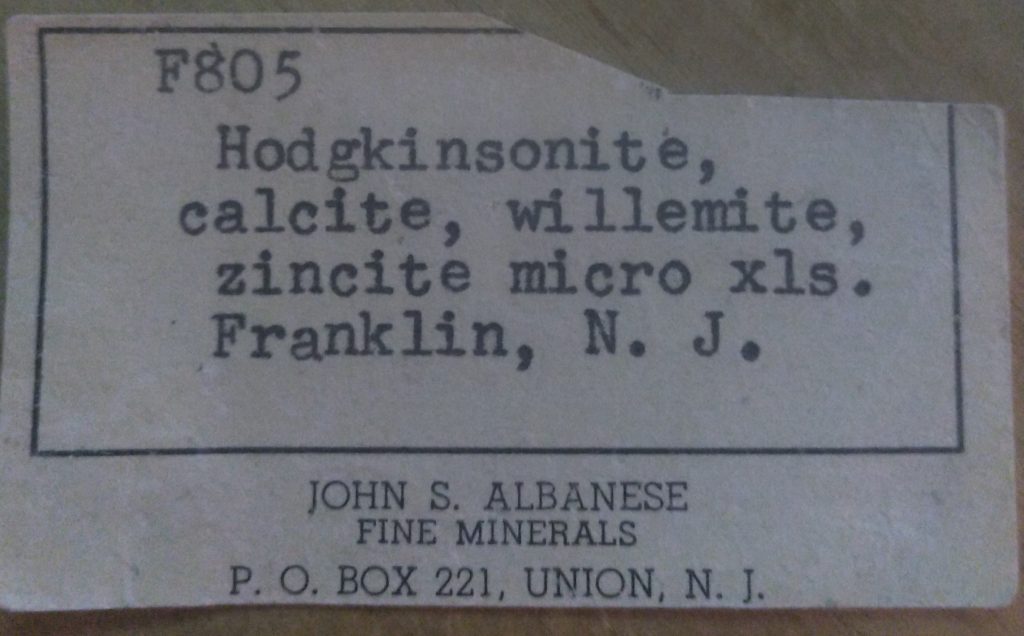
A rare special mineral came to the lab. This was a mineral held by both Albanese and then by Bostwick. It is a rare blue-fluorescing willemite! Hodgkinsonite and calcite are associated. A label remains: “JEM 2458”, and it was suspected to be of a “larsenite assemblage, but not esperite”. Notes indicate this came from Franklin. Under 254nm UV, the edge of this specimen gives a baby blue bright output, reminiscent of hydrozincite. But is this really a willemite? Let’s investigate!
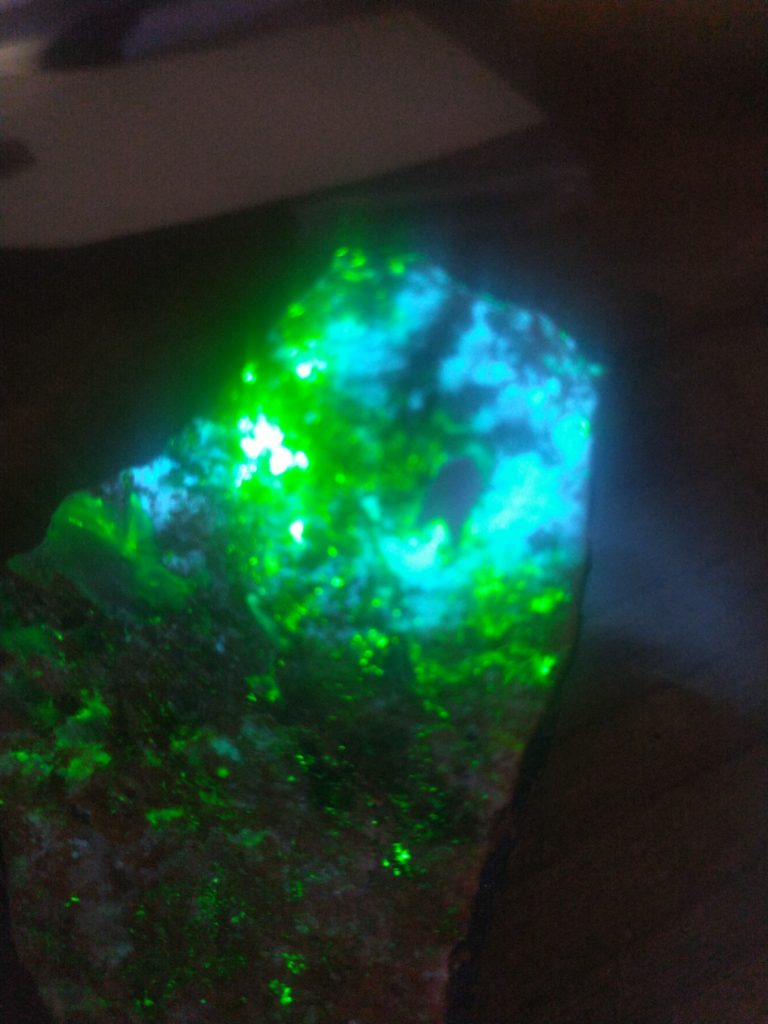
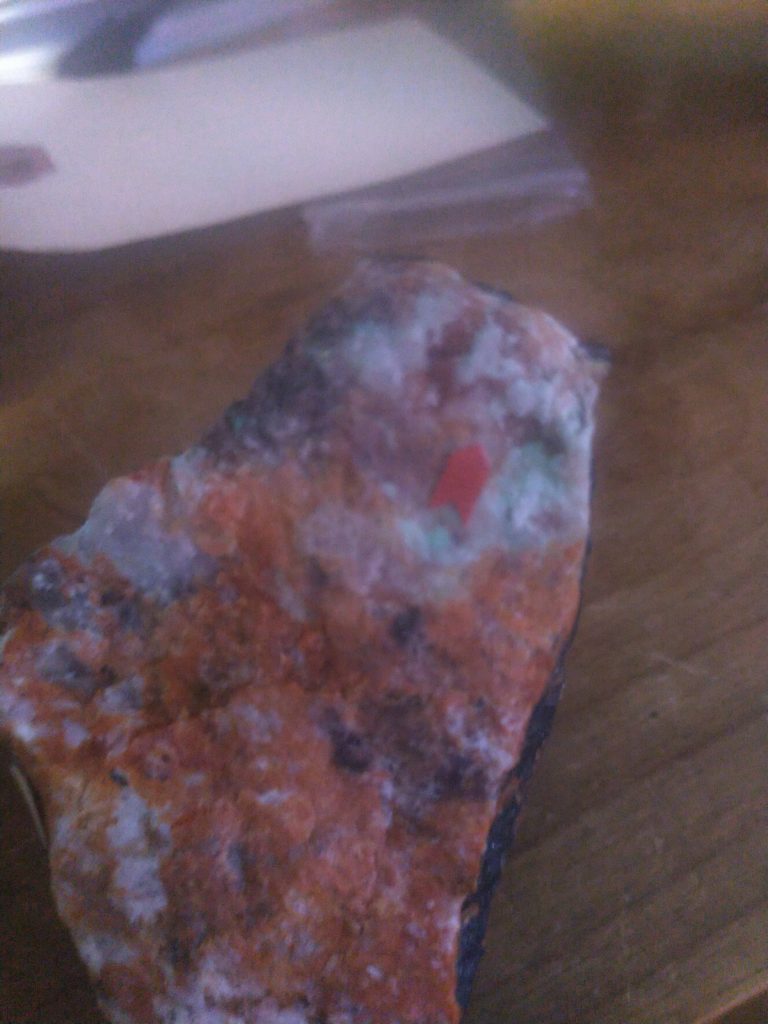
XRF analysis checks the boxes for a typical Franklin-Sterling Hill willemite: a zinc silicate containing manganese. The presence of lead (PbO), however, is remarkable and might be our first clue.
| Run 1 (g/kg) | Run 2 (g/kg) | Run 3 (g/kg) | |
| ZnO | 546 | 486 | 735 |
| Fe2O3 | 101 | 5.72 | 29.9 |
| SiO2 | 96.2 | 36 | 95.8 |
| CaO | 45.1 | 110 | 10.9 |
| MnO | 34.7 | 33.9 | 19.8 |
| SO3 | 13.5 | 5.42 | 10.3 |
| Ga | 6.39 | 5.27 | 11.1 |
| PbO | 3.27 | 2.51 | 7.23 |
| CdO | 0.12 | 0.25 | 0.31 |
| Y | 0.078 | 0.039 | 0.13 |
| SrO | 0.074 | 0.096 | 0 |
| Nb2O5 | 0.066 | 0 | 0.26 |
| K2O | 0 | 0.41 | 0 |
| Rb2O | 0 | 0.027 | 0.057 |
| CeO2 | 0 | 0 | 0.96 |
| Ag | 0 | 0 | 0 |
| ZrO2 | 0 | 0 | 0.11 |
What we suspect is that there are two concurrent emissions at 254nm, resulting from lead (blue) and manganese (green). To confirm this, a fluorescence emission scan was performed at 254nm excitation (10mm slits and a 370nm order sort filter). Two relative maxima are seen: An unexpected 469nm and the usual 525nm line for a Franklin willemite.
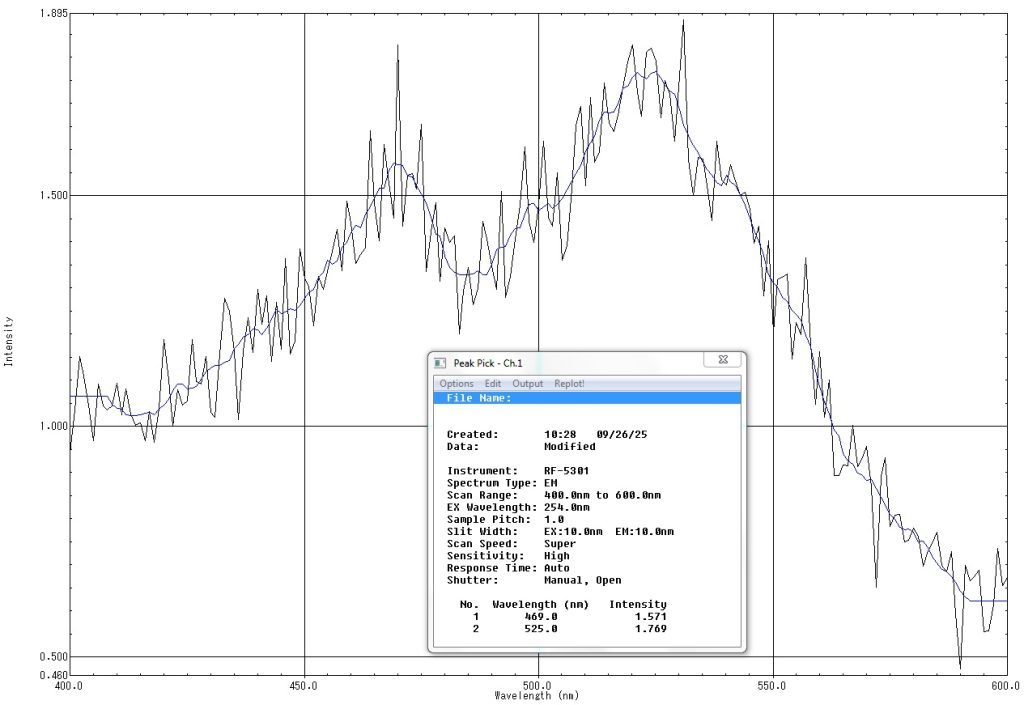
So, is this really a willemite? We say yes! The elemental composition and the 525nm manganese line are our leading indicators. The 525 nm shoulder is Mn²⁺ in willemite (⁴T₁ → ⁶A₁), the classic green fluorescence. In this specimen, lead has migrated into the willemite at the edge of the specimen, and its blue line emits concurrently. The blue line is likely from a Pb-related defect band in the willemite. In natural Franklin material this band is often broad and can peak anywhere ~450–480 nm.
Notes from Albanese and Bostwick (Spex) are provided below!

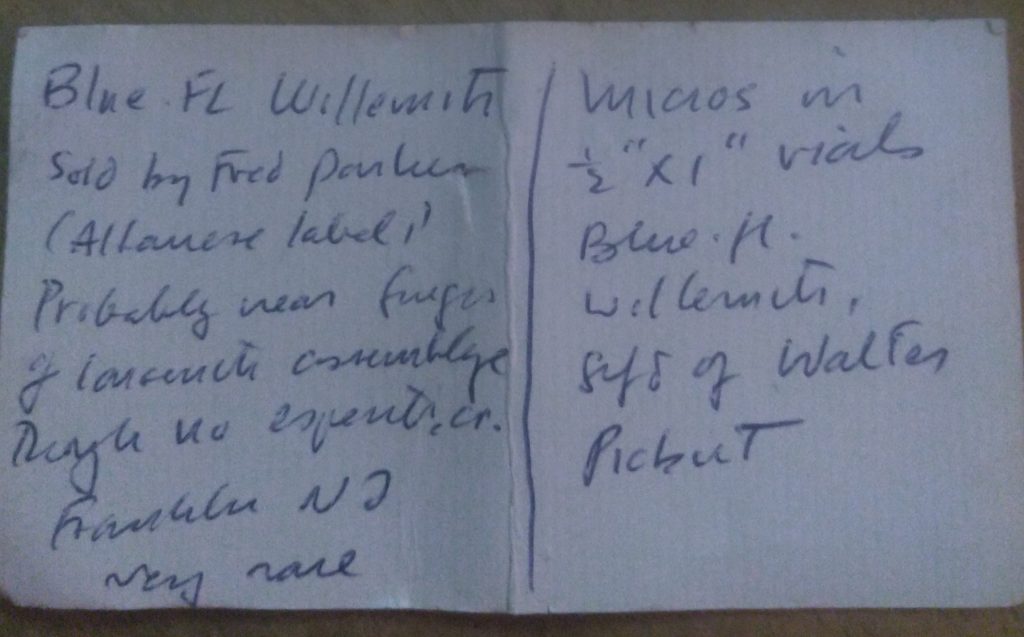
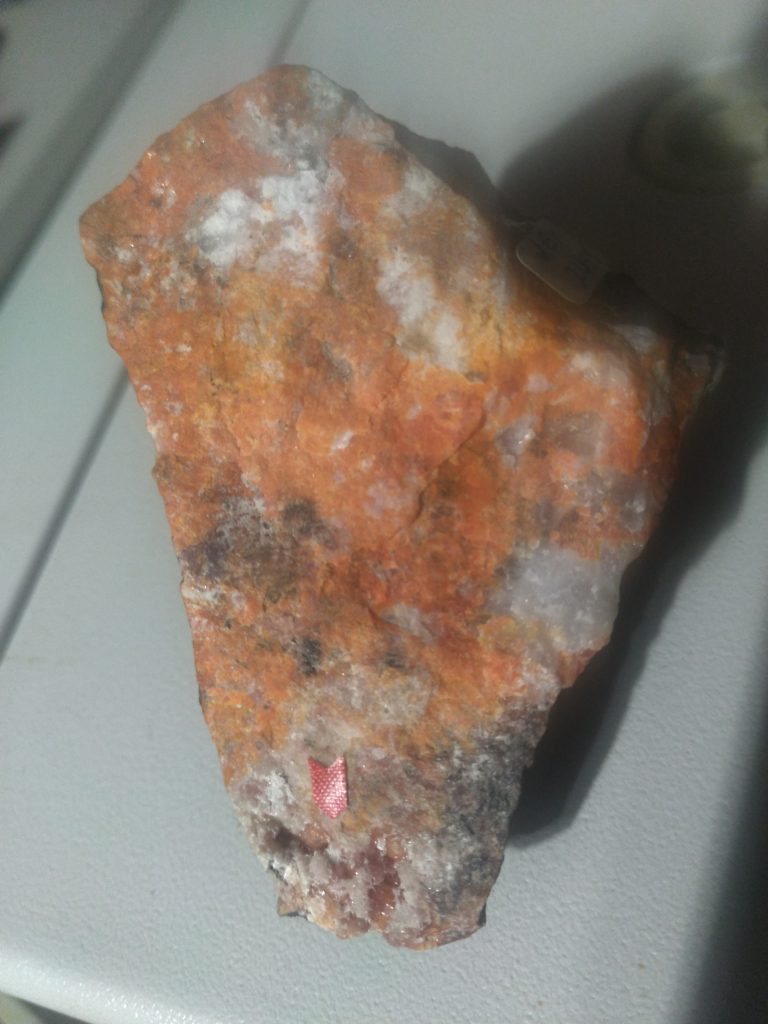

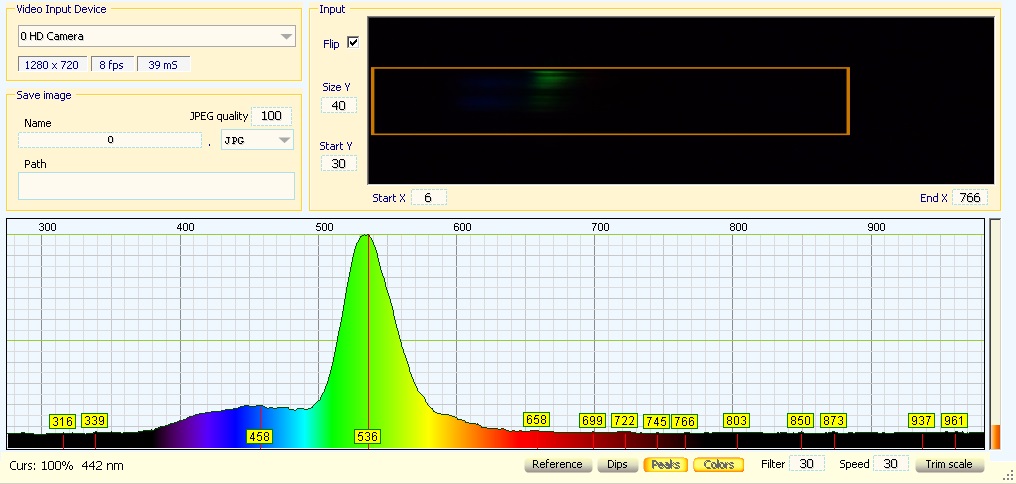
As seen under a Stimac 255nm flashlight and a Theremino – The blue shoulder and the willemite green peak are prominent.
Thermoluminescence (cryo-thermophosphorescence or “CTP”) of Franklin white willemites
August 20, 2025 – An unexpected phenomenon occurs when phosphorescent white willemites are cooled with liquid nitrogen. The long phosphorescence under shortwave UV light temporarily becomes shortened or disappears while the mineral is cold. The opposite effect was expected; kinetically, the phosphorescence should have lasted a very long time but is instead nearly eliminated.
While the mineral is cold, any rapid temperature change will cause the 525nm green fluorescence emission to occur. Heat from your fingers and hand is sufficient to do this, as well as an electric hair dryer at its low setting. No ultraviolet light is required to be present, and the effect occurs in darkness as well as ambient lighting. Once the mineral returns to room temperature, the usual phosphorescence returns.
This video shows liquid nitrogen cooled white willemites responding to human body heat in near darkness with brief phosphorescence (we will check triboluminescence further down this page):
This video shows liquid nitrogen-cooled white willemites responding to a hair dryer in ambient light.
This video shows a fluorescence response from a human hand first, but no response from a rubber mallet, indicating the effect is thermal and not triboluminescence.
This is the first video of the experiment showing the initial cooling of the minerals and phosphoresence checks with overhead and hand-held UV lighting.